The Slave Ship
OUIDAH, EMBARKING TOWARDS MEMORY
It will not sail, but it will take you on a journey
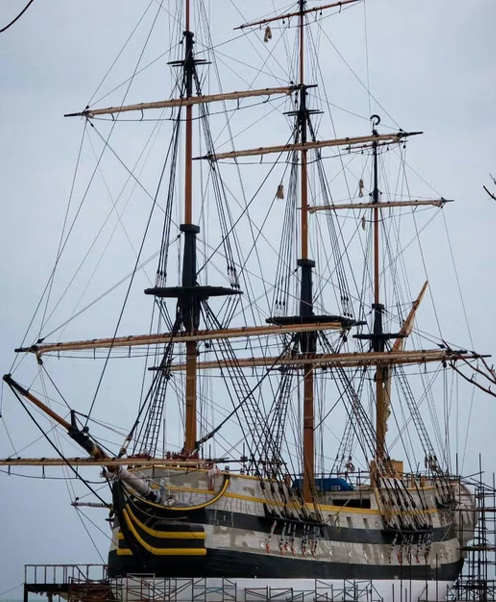
The project, named "Bateau du Départ" (Departure Ship), is not meant to sail the seas. Its mission is far deeper: to allow current and future generations to feel what the transatlantic slave journey was like.
Built at full scale, this 42-meter long, 9-meter wide three-masted ship faithfully reproduces the architecture of the Aurore, an emblematic vessel of the transatlantic trade.
Materials were carefully selected: Oregon pine masts, iroko decks, sturdy ropes, shroud chains, and stainless steel fittings.
A modern construction serving an ancient memory, where every detail is designed to recreate the living conditions on board.
A Horizon Where Memory Takes Shape
On the Beninese coast, facing the Atlantic, the beaches of Ouidah are bathed in light. The wind carries the scent of salt, echoes of Vodun ceremonies, and the steady sound of the waves. But for those who listen closely, this shore also whispers a universal story: the slave trade, which from the 17th to the 19th century, tore millions of men, women, and children from their African lands and dispersed them across the Americas.
It is here, at the starting point of so many broken destinies, that a project of rare symbolic power comes to life: the construction of a memory ship, a replica of an 18th-century slave ship, destined to become one of the major centers of global memorial tourism.
The Sensory Experience of a Motionless Voyage
On board, visitors will not be mere spectators. They will become passengers of memory.
The Holds: dark, narrow, suffocating, they recall the space where hundreds of captives were packed, chained, deprived of air and dignity.
The Between-Deck: designed as an immersive space, it allows understanding of the macabre economy of the trade, between cargoes of goods and human lives treated as merchandise.
The Upper Deck: bathed in light, it offers a breath of fresh air and a view towards the Atlantic horizon—the same horizon that once represented the unknown, the tearing away, hope, or the end.
Visitors will feel the hardness of the planks under their feet, hear the creaking wood, observe the play of light filtering through the gaps, and even, thanks to immersive scenography, hear the sounds of chains, moans, and muffled chants. This is not an exhibition: it is an experience.
A Gateway to the World and the Future
The Departure Ship is not just a Beninese memorial. It is designed as a place for international exchange. Researchers, students, and artists from around the world will be invited for exhibitions, conferences, and creative projects. The ship will become a living memory laboratory, where the voices of Africa, the Americas, the Caribbean, and Europe intersect. In a world where the memory of slavery remains largely unknown or underestimated, Ouidah takes on a responsibility: transforming pain into heritage, turning the past into a shared future.